
Are You A Gold Digger?
.JPG/v1/fill/w_320,h_320/file.jpg)
The Daily Reading For Today Is Ruth 2:

Some scholars have Ruth as an eleventh-generation daughter of the assembly and covenant, but that is highly impossible considering that she does marry Boaz. Boaz would have had to be at least young enough to bear a son, for when we consider the genealogy of Christ, it is clear that Rahab is the mother of Boaz.
Matthew 1:3–6 (NKJV)
3 Judah begot Perez and Zerah by Tamar, Perez begot Hezron, and Hezron begot Ram. 4 Ram begot Amminadab, Amminadab begot Nahshon, and Nahshon begot Salmon. 5 Salmon begot Boaz by Rahab, Boaz begot Obed by Ruth, Obed begot Jesse, 6 and Jesse begot David the king. David the king begot Solomon by her who had been the wife of Uriah.
Therefore since this narrative unfolds in the days of the Judges, the time frame cannot be any later than 150 years after the fall of Jericho, which is when Israel entered the promised land. And that's assuming that Rahab was in her twenties at the time Jericho fell and gave birth to Boaz no later than fifty years after its destruction. For that is the range in which Boaz and Ruth were able to beget Obed according to the Davidic line.
""Ruth should be understood as a true historical account. The reliable facts surrounding Ruth, in addition to its complete compatibility with Judges plus 1 and 2 Samuel, confirm Ruth's authenticity. However, some individual difficulties require careful attention. First, how could Ruth worship at the tabernacle then in Shiloh (1 Sam. 4:4), since Deuteronomy 23:3 expressly forbids Moabites from entering the assembly for ten generations? Since the Jews entered the land ca. 1405 B.C. and Ruth was not born until ca. 1150 B.C., she then represented at least the eleventh generation (probably later) if the time limitation ended at ten generations. If "ten generations" was an idiom meaning "forever" as Nehemiah 13:1 implies, then Ruth would be like the foreigner of Isaiah 56:1–8 who joined himself to the LORD (1:16) thus gaining entrance to the assembly.""
MacArthur, J., Jr. (Ed.). (1997). The MacArthur Study Bible (electronic ed., p. 367). Nashville, TN: Word Pub.
And Matthew makes it clear that he wants us to know that the harlot Rahab was of the Messianic line. Therefore it is impossible to try to answer the question of Deut.23:3 that way by prescribing eleven generations.
Therefore by what means did she enter the assembly of the LORD?
Galatians 3:2–9 (NKJV)
2 This only I want to learn from you: Did you receive the Spirit by the works of the law, or by the hearing of faith?—3 Are you so foolish? Having begun in the Spirit, are you now being made perfect by the flesh? 4 Have you suffered so many things in vain—if indeed it was in vain? 5 Therefore He who supplies the Spirit to you and works miracles among you, does He do it by the works of the law, or by the hearing of faith? 6 just as Abraham "believed God, and it was accounted to him for righteousness." 7 Therefore know that only those who are of faith are sons of Abraham. 8 And the Scripture, foreseeing that God would justify the Gentiles by faith, preached the gospel to Abraham beforehand, saying, "In you all the nations shall be blessed." 9 So then those who are of faith are blessed with believing Abraham.
And doesn't the rest of the narrative answer that question more directly by itself? (4:16-22)
Ruth 4:11–12 (NKJV)
11 And all the people who were at the gate, and the elders, said, "We are witnesses. The Lord make the woman who is coming to your house like Rachel and Leah, the two who built the house of Israel; and may you prosper in Ephrathah and be famous in Bethlehem. 12 May your house be like the house of Perez, whom Tamar bore to Judah, because of the offspring which the Lord will give you from this young woman."
Ruth 4:18–22 (NKJV)
18 Now this is the genealogy of Perez: Perez begot Hezron; 19 Hezron begot Ram, and Ram begot Amminadab; 20 Amminadab begot Nahshon, and Nahshon begot Salmon; 21 Salmon begot Boaz, and Boaz begot Obed; 22 Obed begot Jesse, and Jesse begot David.
Therefore consider the spiritual maturity and revival that is taking place in these communities associated with Boaz. Their knowledge of their spiritual heritage is working for them as a knowledge of God's grace in that Tamar is used as an example that preserves the line of Perez and that Boaz was born of a harlot like Tamar to continue to preserve it. Therefore this is about preserving their holy line in the hope of the promise, understanding that its purpose is about grace more than it is about the letter of the law.
Genesis 38:24–29 (NKJV)
24 And it came to pass, about three months after, that Judah was told, saying, "Tamar your daughter-in-law has played the harlot; furthermore she is with child by harlotry." So Judah said, "Bring her out and let her be burned!" 25 When she was brought out, she sent to her father-in-law, saying, "By the man to whom these belong, I am with child." And she said, "Please determine whose these are—the signet and cord, and staff." 26 So Judah acknowledged them and said, "She has been more righteous than I, because I did not give her to Shelah my son." And he never knew her again. 27 Now it came to pass, at the time for giving birth, that behold, twins were in her womb. 28 And so it was, when she was giving birth, that the one put out his hand; and the midwife took a scarlet thread and bound it on his hand, saying, "This one came out first." 29 Then it happened, as he drew back his hand, that his brother came out unexpectedly; and she said, "How did you break through? This breach be upon you!" Therefore his name was called Perez.

Now, why does Samuel mention the great wealth of Boaz? (v.1)
Does Boaz being single in his old age have anything to do with the responsibility that comes along with this great wealth in Israel? (v.5, 8)
How do we know that he is an aged man but by the manner in which he inquires and conducts himself about Ruth? (v..5, 8)
And what is the significance of Naomi having a kinsman of her husband to top this story off with the character Boaz? (v.1)
Deuteronomy 25:5–10 (NKJV)
5 "If brothers dwell together, and one of them dies and has no son, the widow of the dead man shall not be married to a stranger outside the family; her husband's brother shall go into her, take her as his wife, and perform the duty of a husband's brother to her. 6 And it shall be that the firstborn son which she bears will succeed to the name of his dead brother, that his name may not be blotted out of Israel. 7 But if the man does not want to take his brother's wife, then let his brother's wife go up to the gate to the elders, and say, 'My husband's brother refuses to raise up a name to his brother in Israel; he will not perform the duty of my husband's brother.' 8 Then the elders of his city shall call him and speak to him. But if he stands firm and says, 'I do not want to take her,' 9 then his brother's wife shall come to him in the presence of the elders, remove his sandal from his foot, spit in his face, and answer and say, 'So shall it be done to the man who will not build up his brother's house.' 10 And his name shall be called in Israel, 'The house of him who had his sandal removed.'
What are the facts concerning Naomi's case that qualify for an application of this law? And how are they different than the example offered by the "letter" of the law?
Mark 12:18–27 (NKJV)
18 Then some Sadducees, who say there is no resurrection, came to Him; and they asked Him, saying: 19 "Teacher, Moses wrote to us that if a man's brother dies, and leaves his wife behind, and leaves no children, his brother should take his wife and raise up offspring for his brother. 20 Now there were seven brothers. The first took a wife; and dying, he left no offspring. 21 And the second took her, and he died; nor did he leave any offspring. And the third likewise. 22 So the seven had her and left no offspring. Last of all the woman died also. 23 Therefore, in the resurrection, when they rise, whose wife will she be? For all seven had her as wife." 24 Jesus answered and said to them, "Are you not therefore mistaken, because you do not know the Scriptures nor the power of God? 25 For when they rise from the dead, they neither marry nor are given in marriage, but are like angels in heaven. 26 But concerning the dead, that they rise, have you not read in the book of Moses, in the burning bush passage, how God spoke to him, saying, 'I am the God of Abraham, the God of Isaac, and the God of Jacob'? 27 He is not the God of the dead, but the God of the living. You are therefore greatly mistaken."
Surely, she is a widow and without a son after the death of her husband and two sons, which qualifies her for a kinsman redeemer. But since it is assumed Naomi has passed the age of bearing a son, how does Ruth qualify for a kinsman redeemer?
Nehemiah 13:1–3 (NKJV)
1 On that day they read from the Book of Moses in the hearing of the people, and in it was found written that no Ammonite or Moabite should ever come into the assembly of God, 2 because they had not met the children of Israel with bread and water, but hired Balaam against them to curse them. However, our God turned the curse into a blessing. 3 So it was, when they had heard the Law, that they separated all the mixed multitude from Israel.
It appears then that the promise supersedes the curse. For it says, "Our God turned the curse into a blessing."
Galatians 3:15–25 (NKJV)
15 Brethren, I speak in the manner of men: Though it is only a man's covenant, yet if it is confirmed, no one annuls or adds to it. 16 Now to Abraham and his Seed were the promises made. He does not say, "And to seeds," as of many, but as of one, "And to your Seed," who is Christ. 17 And this I say, that the law, which was four hundred and thirty years later, cannot annul the covenant that was confirmed before by God in Christ, that it should make the promise of no effect. 18 For if the inheritance is of the law, it is no longer of promise; but God gave it to Abraham by promise. 19 What purpose then does the law serve? It was added because of transgressions, till the Seed should come to whom the promise was made; and it was appointed through angels by the hand of a mediator. 20 Now a mediator does not mediate for one only, but God is one. 21 Is the law then against the promises of God? Certainly not! For if there had been a law given which could have given life, truly righteousness would have been by the law. 22 But the Scripture has confined all under sin, that the promise by faith in Jesus Christ might be given to those who believe. 23 But before faith came, we were kept under guard by the law, kept for the faith which would afterward be revealed. 24 Therefore the law was our tutor to bring us to Christ, that we might be justified by faith. 25 But after faith has come, we are no longer under a tutor.
Genesis 3:13–15 (NKJV)
13 And the Lord God said to the woman, "What is this you have done?" The woman said, "The serpent deceived me, and I ate." 14 So the Lord God said to the serpent: "Because you have done this, You are cursed more than all cattle, And more than every beast of the field; On your belly you shall go, And you shall eat dust All the days of your life. 15 And I will put enmity Between you and the woman, And between your seed and her Seed; He shall bruise your head, And you shall bruise His heel."
Therefore are we to exalt one law above another in value and virtue in order to annul the promise of God's grace?
Isaiah 56:3–8 (NKJV)
3 Do not let the son of the foreigner Who has joined himself to the Lord Speak, saying, "The Lord has utterly separated me from His people"; Nor let the eunuch say, "Here I am, a dry tree." 4 For thus says the Lord: "To the eunuchs who keep My Sabbaths, And choose what pleases Me, And hold fast My covenant, 5 Even to them I will give in My house And within My walls a place and a name Better than that of sons and daughters; I will give them an everlasting name That shall not be cut off. 6 "Also the sons of the foreigner Who join themselves to the Lord, to serve Him, And to love the name of the Lord, to be His servants— Everyone who keeps from defiling the Sabbath, And holds fast My covenant— 7 Even them I will bring to My holy mountain, And make them joyful in My house of prayer. Their burnt offerings and their sacrifices Will be accepted on My altar; For My house shall be called a house of prayer for all nations." 8 The Lord God, who gathers the outcasts of Israel, says, "Yet I will gather to him Others besides those who are gathered to him."
Deuteronomy 10:17–20 (NKJV)
17 For the Lord your God is God of gods and Lord of lords, the great God, mighty and awesome, who shows no partiality nor takes a bribe. 18 He administers justice for the fatherless and the widow, and loves the stranger, giving him food and clothing. 19 Therefore love the stranger, for you were strangers in the land of Egypt. 20 You shall fear the Lord your God; you shall serve Him, and to Him you shall hold fast, and take oaths in His name.
Deuteronomy 24:17–19 (NKJV)
17 "You shall not pervert justice due the stranger or the fatherless, nor take a widow's garment as a pledge. 18 But you shall remember that you were a slave in Egypt, and the Lord your God redeemed you from there; therefore I command you to do this thing. 19 "When you reap your harvest in your field, and forget a sheaf in the field, you shall not go back to get it; it shall be for the stranger, the fatherless, and the widow, that the Lord your God may bless you in all the work of your hands.
Deuteronomy 27:19 (NKJV)
19 'Cursed is the one who perverts the justice due the stranger, the fatherless, and widow.' "And all the people shall say, 'Amen!'
Therefore was it wrong for Ruth to find a way to provide for her family of one, her mother-in-law? (v.2)
But more importantly, how does this demonstrate her character before all of Israel as an outsider and, as the testimony puts it, a Moabitess? (v.3)
Numbers 25:1–5 (NKJV)
1 Now Israel remained in Acacia Grove, and the people began to commit harlotry with the women of Moab. 2 They invited the people to the sacrifices of their gods, and the people ate and bowed down to their gods. 3 So Israel was joined to Baal of Peor, and the anger of the Lord was aroused against Israel. 4 Then the Lord said to Moses, "Take all the leaders of the people and hang the offenders before the Lord, out in the sun, that the fierce anger of the Lord may turn away from Israel." 5 So Moses said to the judges of Israel, "Every one of you kill his men who were joined to Baal of Peor."
So what's the difference here between elders that married the daughters of Baal between Ruth and Boaz as their encounter begins in the gleaning fields? Isn't it the mediator of the marriage covenant? (Num.25:1-3)
1 Corinthians 10:20–22 (NKJV)
20 Rather, that the things which the Gentiles sacrifice they sacrifice to demons and not to God, and I do not want you to have fellowship with demons. 21 You cannot drink the cup of the Lord and the cup of demons; you cannot partake of the Lord's table and of the table of demons. 22 Or do we provoke the Lord to jealousy? Are we stronger than He?
Therefore since the days of Boaz were so soon after Israel was made to possess the land for at least 70 years and for at least 40 more after Joshua's death, how could a Moabitess be trusted to be present in the land? (v.10)
Judges 3:11–14 (NKJV)
11 So the land had rest for forty years. Then Othniel, the son of Kenaz, died. 12 And the children of Israel again did evil in the sight of the Lord. So the Lord strengthened Eglon, king of Moab, against Israel because they had done evil in the sight of the Lord. 13 Then he gathered to himself the people of Ammon and Amalek, went and defeated Israel, and took possession of the City of Palms. 14 So the children of Israel served Eglon king of Moab eighteen years.
""The story of Ruth occurred in the days "when the judges ruled" Israel (1:1) ca. 1370 to 1041 B.C. (Judg. 2:16–19) and thus bridges time from the judges to Israel's monarchy. God used "a famine in the land" of Judah (1:1) to set in motion this beautiful drama, although the famine does not receive mention in Judges which causes difficulty in dating the events of Ruth. However, by working backward in time from the well known date of David's reign (1011–971 B.C.), the time period of Ruth would most likely be during the judgeship of Jair,? ca. 1126–1105 B.C. (Judg. 10:3–5).
Ruth covers about 11–12 years according to the following scenario: 1) 1:1–18, ten years in Moab (1:4); 2) 1:19–2:23, several months (mid-Apr. to mid-June) in Boaz's field (1:22; 2:23); 3) 3:1–18, one day in Bethlehem and one night at the threshing floor; and 4) 4:1–22, about one year in Bethlehem.""
MacArthur, J., Jr. (Ed.). (1997). The MacArthur Study Bible (electronic ed., p. 366). Nashville, TN: Word Pub.
Therefore it is more likely that this narrative unfolds during the eighty years after Ehud, the Judge, made peace with Moab. And it is even more likely during the early stages and transition of that peace, which is how Naomi may have lost her husband and two sons, who were named "Sick" and "Pining," as they were perishing away at the hand of Eglon, the king, during the ten years that she spent in Moab where her husband and her sons did die.
[Machlown /makh·lone/] n pr m. From 2470; GK 4705; Four occurrences; AV translates as "Mahlon" four times. 1 son of Elimelech by Naomi and first husband of Ruth. Additional Information: Mahlon = “sick”.
[Kilyown /kil·yone/] n pr m. A form of 3631; GK 4002; Three occurrences; AV translates as "Chilion" three times. 1 an Ephraimite and son of Elimelech by Naomi and the deceased husband of Ruth (or maybe deceased husband of Orpah). Additional Information: Chilion = “pining”.
Strong, J. (1995). Enhanced Strong's Lexicon. Woodside Bible Fellowship.
Therefore since there was a famine in the land (of Judah), Elimelech must have sold himself, and thus his two sons, as forced laborers into the hand of Eglon, the king at that time, who fearlessly sucked the life right out of them till there was nothing left.
Therefore it is by God's sovereign Providence that Ruth gleans upon the field of Boaz, contrary to how the popular romance movies portray the narrative. (v.3)
So she was not "gold-digging" for the favor of Boaz's riches, which is why we asked why Boaz was single all the way up to his later years.
Ruth 3:10 (NKJV)
10 Then he said, "Blessed are you of the Lord, my daughter! For you have shown more kindness at the end than at the beginning, in that you did not go after young men, whether poor or rich.
Again, how is Samuel building us with the good character and sound wisdom of Boaz? What kind of man was Boaz towards his workers, and how was Boaz respected in return by them? (v.4)
Ephesians 6:5–9 (NKJV)
5 Bondservants, be obedient to those who are your masters according to the flesh, with fear and trembling, in sincerity of heart, as to Christ; 6 not with eyeservice, as men-pleasers, but as bondservants of Christ, doing the will of God from the heart, 7 with goodwill doing service, as to the Lord, and not to men, 8 knowing that whatever good anyone does, he will receive the same from the Lord, whether he is a slave or free. 9 And you, masters, do the same things to them, giving up threatening, knowing that your own Master also is in heaven, and there is no partiality with Him.
Colossians 3:22–4:1 (NKJV)
22 Bondservants, obey in all things your masters according to the flesh, not with eyeservice, as men-pleasers, but in sincerity of heart, fearing God. 23 And whatever you do, do it heartily, as to the Lord and not to men, 24 knowing that from the Lord you will receive the reward of the inheritance; for you serve the Lord Christ. 25 But he who does wrong will be repaid for what he has done, and there is no partiality. 1 Masters, give your bondservants what is just and fair, knowing that you also have a Master in heaven.
What did Boaz see in Ruth before he knew anything about her that he inquired his slave of her? Wasn't he more concerned with why she was out gleaning instead of the assumed man responsible for her? And therefore wasn't he amazed by the quality of her labor in the fields? (v.5)
And what does the response say of how small of a town Ephrathah was? (v.6)
Therefore there was this caring and loving culture that was being engrafted into the soul of this town by the example of Boaz to look out for your neighbor's best welfare. (v.7)
Philippians 2:1–4 (NKJV)
1 Therefore if there is any consolation in Christ, if any comfort of love, if any fellowship of the Spirit, if any affection and mercy, 2 fulfill my joy by being like-minded, having the same love, being of one accord, of one mind. 3 Let nothing be done through selfish ambition or conceit, but in lowliness of mind let each esteem others better than himself. 4 Let each of you look out not only for his own interests, but also for the interests of others.

How is Boaz demonstrating a genuine love for Yahweh with all of his heart and mind to look upon Ruth as a daughter and to instruct her in the righteous way of the Law of God's grace, being a master and owner of the Lord's promised land? (v.8)
And how does Boaz assure her that she is at liberty to glean as much as she desires and to go beyond that by making himself hospitable to her? (v.9)
1 Corinthians 3:5–11 (NKJV)
5 Who then is Paul, and who is Apollos, but ministers through whom you believed, as the Lord gave to each one? 6 I planted, Apollos watered, but God gave the increase. 7 So then neither he who plants is anything, nor he who waters, but God who gives the increase. 8 Now he who plants and he who waters are one, and each one will receive his own reward according to his own labor. 9 For we are God's fellow workers; you are God's field, you are God's building. 10 According to the grace of God which was given to me, as a wise master builder I have laid the foundation, and another builds on it. But let each one take heed how he builds on it. 11 For no other foundation can anyone lay than that which is laid, which is Jesus Christ.
Again, was Ruth looking to be noticed by (the man) of the field or by (a man) of the field? And was she expecting to be noticed at all, considering her external image as a Moabite woman? (v.10)
Isn't it better to be seen and known for what is true about you than for what is portrayed about you by others? Therefore what did Boaz know about her before he saw her and heard of her from the harvesters (v.6, 11)

Therefore isn't she observed by Boaz after the reality of her heart than what her image is according to the Law and the slander of others who would choose to see her as a gold-digger because they are ignorant of the Law? (v.12)
Why does Boaz recognize her gleaning as work and account it to her as a wage if it is not because he sees her labor as loyalty unto Yahweh since she left her family and her father's gods to abide with the elderly widow Naomi? (v.13)

Again, what does this say of the character of Boaz in that he serves his laborers? (v.14)
Luke 17:3–10 (NKJV)
3 Take heed to yourselves. If your brother sins against you, rebuke him; and if he repents, forgive him. 4 And if he sins against you seven times in a day, and seven times in a day returns to you, saying, 'I repent,' you shall forgive him." 5 And the apostles said to the Lord, "Increase our faith." 6 So the Lord said, "If you have faith as a mustard seed, you can say to this mulberry tree, 'Be pulled up by the roots and be planted in the sea,' and it would obey you. 7 And which of you, having a servant plowing or tending sheep, will say to him when he has come in from the field, 'Come at once and sit down to eat'? 8 But will he not rather say to him, 'Prepare something for my supper, and gird yourself and serve me till I have eaten and drunk, and afterward you will eat and drink'? 9 Does he thank that servant because he did the things that were commanded him? I think not. 10 So likewise you, when you have done all those things which you are commanded, say, 'We are unprofitable servants. We have done what was our duty to do.'"

And why does Boaz go out of his way to make sure that his workers do not insult her for being a Moabitess? (v.15)
Exodus 23:17–19 (NKJV)
17 "Three times in the year all your males shall appear before the Lord God. 18 "You shall not offer the blood of My sacrifice with leavened bread; nor shall the fat of My sacrifice remain until morning. 19 The first of the firstfruits of your land you shall bring into the house of the Lord your God. You shall not boil a young goat in its mother's milk.
Exodus 34:23–26 (NKJV)
23 "Three times in the year all your men shall appear before the Lord, the Lord God of Israel. 24 For I will cast out the nations before you and enlarge your borders; neither will any man covet your land when you go up to appear before the Lord your God three times in the year. 25 "You shall not offer the blood of My sacrifice with leaven, nor shall the sacrifice of the Feast of the Passover be left until morning. 26 "The first of the firstfruits of your land you shall bring to the house of the Lord your God. You shall not boil a young goat in its mother's milk."
Deuteronomy 14:20–21 (NKJV)
20 "You may eat all clean birds. 21 "You shall not eat anything that dies of itself; you may give it to the alien who is within your gates, that he may eat it, or you may sell it to a foreigner; for you are a holy people to the Lord your God. "You shall not boil a young goat in its mother's milk.
And therefore, what does this say about Boaz's knowledge of the purpose and intent of God's Law? (v.16)
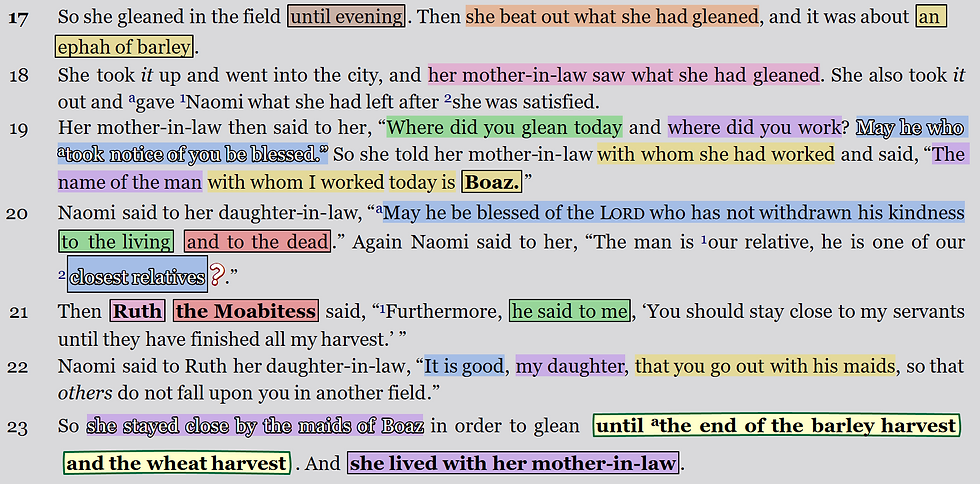
What was a day's labor of her work worth? (v.17)
1 Samuel 1:24 (NKJV)
24 Now when she had weaned him, she took him up with her, with three bulls, one ephah of flour, and a skin of wine, and brought him to the house of the Lord in Shiloh. And the child was young.
(ʾê·p̄ā(h)): n.fem.; ≡ Str 374; TWOT 82—1. LN 81.20–81.24 ephah, i.e., a dry grain measurement, variously reckoned, but usually about 22 liters of volume (Ex 16:36; Lev 5:11; 6:13[EB 20]; 19:36; Nu 5:15; 28:5; Dt 25:14,15; Jdg 6:19; Ru 2:17; 1Sa 1:24; 17:17; Pr 20:10; Isa 5:10; Eze 45:10–46:14 passim; Am 8:5; Mic 6:10); 2. LN 6.118–6.151 basket, i.e., a large basket which could contain a large volume (Zec 5:6, 7, 8, 9, 10+), note: apparently in these contexts the precise standardized unit is not meant; 3. LN 81.20–81.24 אֵיפָה וְ־ אֵיפָה (ʾê·p̄ā(h) w- ʾê·p̄ā(h)) two differing measures, formally, ephah and ephah, i.e., a measure which is not standardized and has a weight or volume which favors one party over another (Dt 25:14; Pr 20:10+)
Swanson, J. (1997). Dictionary of Biblical Languages with Semantic Domains : Hebrew (Old Testament) (electronic ed.). Oak Harbor: Logos Research Systems, Inc.
So there was more than enough left to share with Naomi, who was staying in the city. (v.18)
In what way was Naomi praying for Ruth? (v.19)
Psalm 41:1 (NKJV)
1 Blessed is he who considers the poor; The Lord will deliver him in time of trouble.
What does Naomi mean by "the living and the dead" in her response back to Ruth's report concerning Boaz? Does she think she is dead because of her womb and that Ruth is able to live on? Therefore how is she showing confidence in her daughter-in-law? (v.20)
Ruth 4:16–17 (NKJV)
16 Then Naomi took the child and laid him on her bosom, and became a nurse to him. 17 Also the neighbor women gave him a name, saying, “There is a son born to Naomi.” And they called his name Obed. He is the father of Jesse, the father of David.
How is Samuel forcing the reader to remember not to get their hopes up concerning the testimony of Ruth in light of the legalistic culture that they abide under if it is not by reminding us that she is a Moabite? (v.21)
Therefore, in conclusion to this chapter, what does it say about how Boaz operated his assets? Did he view his laboring fields by the principle to gather all you can in order to give all you can for the welfare of the whole community without compromising the command to credit the individual laborers for their own work? (v.23)
Galatians 6:1–10 (NKJV)
1 Brethren, if a man is overtaken in any trespass, you who are spiritual restore such a one in a spirit of gentleness, considering yourself lest you also be tempted. 2 Bear one another's burdens, and so fulfill the law of Christ. 3 For if anyone thinks himself to be something, when he is nothing, he deceives himself. 4 But let each one examine his own work, and then he will have rejoicing in himself alone, and not in another. 5 For each one shall bear his own load. 6 Let him who is taught the word share in all good things with him who teaches. 7 Do not be deceived, God is not mocked; for whatever a man sows, that he will also reap. 8 For he who sows to his flesh will of the flesh reap corruption, but he who sows to the Spirit will of the Spirit reap everlasting life. 9 And let us not grow weary while doing good, for in due season we shall reap if we do not lose heart. 10 Therefore, as we have opportunity, let us do good to all, especially to those who are of the household of faith.


Comments