
The daily reading for 7/18/22 is Judges 1:
- Mark A. Smith
.JPG/v1/fill/w_320,h_320/file.jpg)
- Jul 18, 2022
- 5 min read

Does chapter one intersect Joshua and Judges as if they were bound together? (v.1)
Since Joshua has passed, through what source did the LORD speak to Judah if it wasn't from their inquiry at the tabernacle of LORD and of the high priest? (v.1-2)
Why was it wise for Judah and Simeon to work together to obtain their inheritance? (v.3)
Shouldn't all of the tribes have followed this example and unifying wisdom rather than stealing from their weaker brother like Joseph over Dan? (v.34-35)
Wasn't it wrong for Joseph to take tribute from Dan's inheritance? (v.35)
What is the blasphemy of this king of Bezek since he is titled "Adoni-bezek" (Lord of lightening)? (v.4)
How were these kings linked to Baal worship being lords of these particular sovereign attributes of Almighty God? (v.5)
Therefore isn't it because of this that the Holy Spirit is determined to record their judgment in detail? (v.6-7)
How many times was Jerusalem taken and retaken by Israel during the time of Joshua and the Judges? (v.8, 21) (Josh.10:5, 23; 12:10; 15:8, 63)

Or was Jerusalem like the other cities (v.27), which were made up of multiple villages and, therefore, the largest village was the one Judah burned but as a city of small villages was regained by the Jebusites? (v.21)
Again, how does the story of Caleb match precisely here with the record of it in Joshua 15? (v.11-15)
Therefore what does that tell us about the authorship of Joshua from at least chapter fifteen on since this event was after his death?
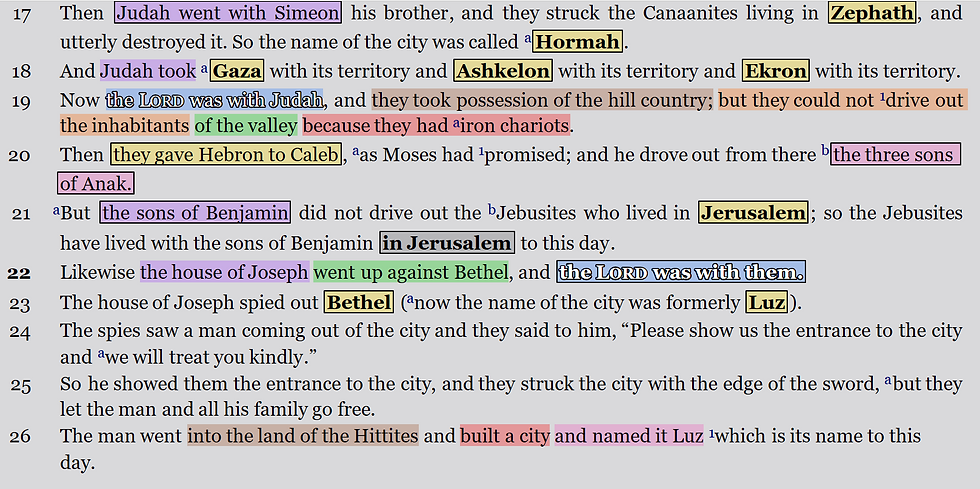
What is the connection here between Caleb's daughter and the descendants of the Kenite, which were most likely Moses' ex-wife's children, to a son-in-law of Jethro? Why would the author of Judges mention that here?
Genesis 15:18–19 (NKJV)
18 On the same day, the Lord made a covenant with Abram, saying: "To your descendants, I have given this land, from the river of Egypt to the great river, the River Euphrates—19 the Kenites, ...
Numbers 24:21–22 (NKJV)
21 Then he looked on the Kenites, and he took up his oracle and said: "Firm is your dwelling place, And your nest is set in the rock; 22 Nevertheless Kain shall be burned. How long until Asshur carries you away captive?"
Judges 4:11 (NKJV)
11 Now Heber the Kenite, of the children of Hobab, the father-in-law of Moses, had separated himself from the Kenites and pitched his tent near the terebinth tree at Zaanaim, which is beside Kedesh.
It seems that Caleb may have been made responsible for protecting Zipporah's children since Caleb was a son of Judah.
Numbers 10:29–33 (NKJV)
29 Now Moses said to Hobab, the son of Reuel the Midianite, Moses' father-in-law, "We are setting out for the place of which the Lord said, 'I will give it to you.' Come with us, and we will treat you well, for the Lord has promised good things to Israel." 30 And he said to him, "I will not go, but I will depart to my own land and to my relatives." 31 So Moses said, "Please do not leave, inasmuch as you know how we are to camp in the wilderness, and you can be our eyes. 32 And it shall be if you go with us—indeed it shall be—that whatever good the Lord will do to us, the same we will do to you." 33 So they departed from the mountain of the Lord on a journey of three days; and the ark of the covenant of the Lord went before them for the three days' journey, to search out a resting place for them.
Why was Caleb honored with Hebron if it wasn't because of the vengeance owed him due to his faith in obtaining the promised land from the so-called giants that Israel feared? Was Caleb counted as untrustworthy by the Jews because of his name, which is translated as a dog?
(kě·lěḇ): n.masc.; ≡ Str 3611; TWOT 981a—1. LN 4.34 dog, i.e., a mammal of the Canus family (1Ki 14:11; Pr 26:11), note: this animal was not clean for ritual sacrifice, and never referred to as ceremonially clean for eating; 2. LN 87.58–87.75 dog, i.e., a person of low status (1Sa 17:43; 2Ki 8:13); 3. LN 88.271–88.282 male prostitute (Dt 23:19+); 4. LN 88.105–88.125 evil person, formally, a dog, i.e., a violent, evil person (Ps 22:17[EB 16]); 5. LN 88.271–88.282 unit: כֶּלֶב מוּת (kě·lěḇ mûṯ) scum, formally, dead dog, i.e., a person of very low status (1Sa 24:15[EB 14]; 2Sa 9:8; 16:9); 6. LN 37.111–37.113 unit: רֹאשׁ כֶּלֶב (rō(ʾ)š kě·lěḇ) puppet, formally, a dog’s head, i.e., a person of low status in the pay of another as a traitor (2Sa 3:8), see also domain LN 88.271–88.282
(kā·lēḇ): n.pr. [Holladay: and tribe]; ≡ Str 3612;—LN 93-pers. (male) Caleb: of Judah, a compatriot of Joshua, optimistic explorer of Promised Land (Nu 13:6; Nu 14:6), see also 3992, 3982; also, a part of a compound name, Caleb Ephrathah, see 3980
Swanson, J. (1997). Dictionary of Biblical Languages with Semantic Domains : Hebrew (Old Testament) (electronic ed.). Oak Harbor: Logos Research Systems, Inc.
Numbers 13:27–33 (NKJV)
27 Then they told him and said: "We went to the land where you sent us. It truly flows with milk and honey, and this is its fruit. 28 Nevertheless, the people who dwell in the land are strong; the cities are fortified and very large; moreover, we saw the descendants of Anak there. 29 The Amalekites dwell in the land of the South; the Hittites, the Jebusites, and the Amorites dwell in the mountains; and the Canaanites dwell by the sea and along the banks of the Jordan." 30 Then Caleb quieted the people before Moses and said, "Let us go up at once and take possession, for we are well able to overcome it." 31 But the men who had gone up with him said, "We are not able to go up against the people, for they are stronger than we." 32 And they gave the children of Israel a bad report of the land which they had spied out, saying, "The land through which we have gone as spies is a land that devours its inhabitants, and all the people whom we saw in it are men of great stature. 33 There we saw the giants (the descendants of Anak came from the giants); and we were like grasshoppers in our own sight, and so we were in their sight."

Why does it say that the Canaanites lived among the sons of Israel in verses 27-30 until we see a transition in Asher and Naphtali where it says the Asherites lived among the Canaanites? (v.32-33)
Doesn't that mean the Canaanites were the dominant inhabitants of those lands? Yet how were they still considered under forced labor if it wasn't because they weren't able to defend their fields of labor during harvest time?

How will these roles switch over the course of time?




Comments